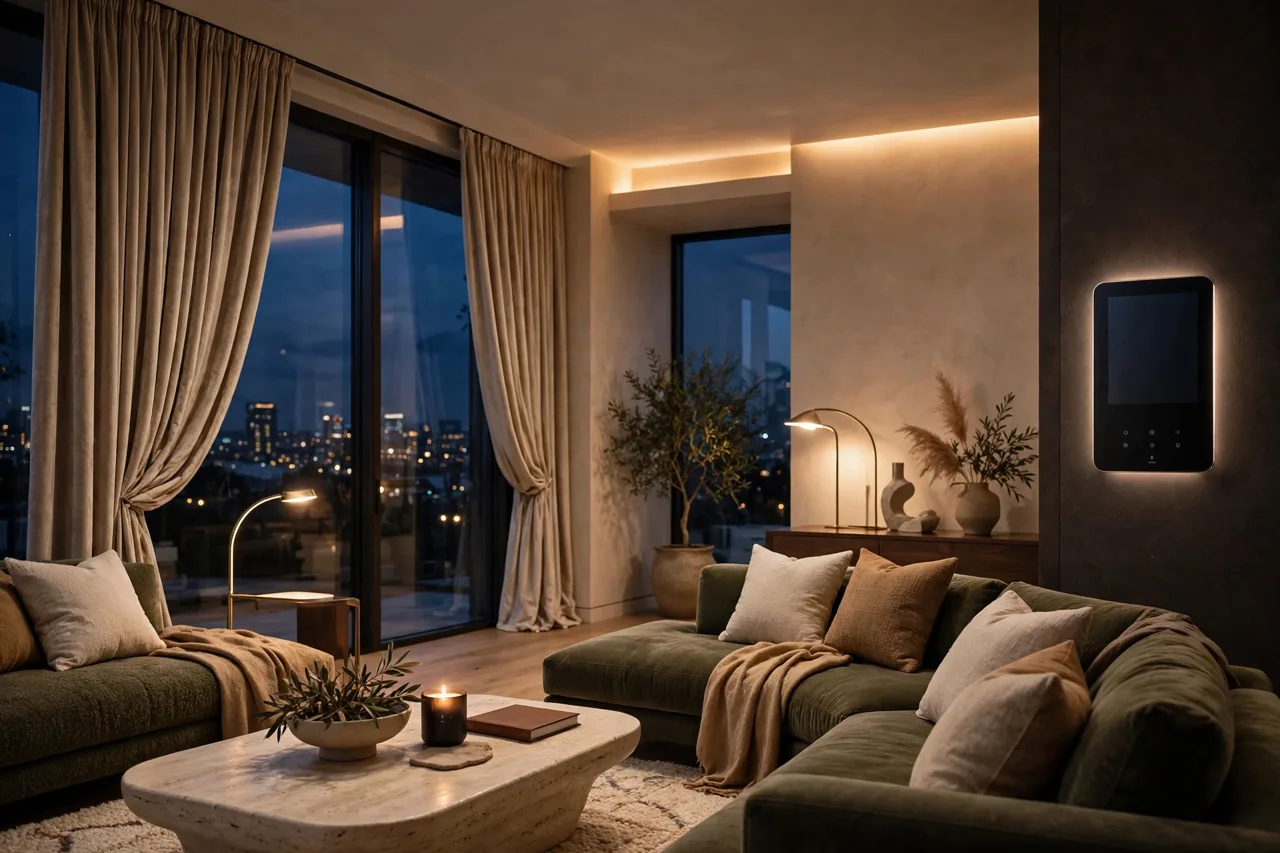

The finest homes have always been designed around comfort; today they are increasingly designed around intelligence too. Smart home technology in a luxury property is no longer about gadgets for their own sake — it is about lighting that sets itself for the evening, heating that learns the rhythm of the house, and security that watches quietly in the background. Done well, none of it shouts. This guide explains what premium smart home technology actually includes, what to prioritise, and how to plan a system that feels like part of the architecture rather than an afterthought.
Start with the infrastructure, not the gadgets
Every reliable smart home stands on invisible foundations: strong structured cabling, a professionally designed Wi-Fi network and a central rack where the equipment lives. Wireless gadgets added one at a time can work in a flat; in a large house with thick walls and multiple floors, they quickly become temperamental. A proper design runs data cables to key points, plans Wi-Fi access points for seamless coverage, and leaves spare capacity for future additions. It costs more at the start and saves money — and frustration — for years. Think of it the way premium car owners think about servicing: the unglamorous groundwork is what makes the experience feel effortless, much like the standards behind luxury vehicle ownership.
Lighting: the single biggest transformation
Intelligent lighting is where smart technology earns its keep first. Scenes replace switches: one touch sets the dining room for dinner, another dims the whole house for the night. Circadian settings shift colour temperature through the day, warmer in the evening to match natural light. Exterior lighting can follow sunset automatically, and a single “away” scene simulates occupancy while you travel. The key to luxury lighting is control that suits everyone — elegant keypads on the wall for guests, an app for the family, and voice control where it genuinely helps. Pair it with considered interior choices, such as the principles in our guide to building a capsule wardrobe, and the whole home starts to feel calmly intentional rather than cluttered.
Climate, shading and comfort
Smart heating and cooling zones each room individually, so the bedrooms stay cool while the living spaces stay warm, and energy is not wasted on empty floors. Underfloor heating, air conditioning and ventilation can all sit on one system that reacts to weather forecasts and learns from use. Automated blinds and curtains are the other half of comfort: they close against low winter sun, protect artwork and furniture from UV, and open to the morning light on a schedule. For country houses especially, shading also adds privacy without a single net curtain. Owners planning a driving tour while the house looks after itself may enjoy our guide to planning a luxury driving tour of the UK — the modern pleasure is returning to a home already set for the evening.
Security that stays in the background
Premium security is discreet: cameras integrated into the landscaping, video entry systems that let you answer the gate from anywhere in the world, and smart locks that record who came and went without a pocketful of keys. Alerts should be intelligent too — distinguishing a fox from a person saves the 3 a.m. false alarms that make people switch systems off. Lighting, security and entry work best as one design, so a car arriving after dark triggers the driveway lights, the hall scene and a notification in a single quiet sequence. It is the domestic equivalent of the detailing standards in our piece on ceramic coating for premium cars: protection you barely notice until you need it.
Entertainment woven into the rooms
Multi-room audio, hidden speakers and a dedicated cinema room remain the classic luxury requests, but the modern emphasis is invisibility: televisions that become mirrors or art when off, speakers plastered into ceilings, and one remote — or none — instead of five. A well-designed system is simple enough for any guest to use, which is the real test. If your evenings out are as considered as your evenings in, our guide to planning a London theatre trip pairs nicely with a home that welcomes you back properly afterwards.
Energy management and sustainability
A well-designed system also manages energy intelligently. Solar generation, battery storage and the heating system can be coordinated so the house uses its own power first, heats water when the sun shines and charges an electric car overnight at the cheapest rate. Smart meters and per-circuit monitoring show exactly where energy goes — often revealing a hot tub, an old freezer or a pool pump quietly costing more than everything else combined. For large period properties, where insulation options are limited by listed-building rules, this kind of intelligent management is frequently the most effective sustainability measure available. None of it requires the owners to think about it daily; the house simply wastes less. It pairs naturally with the care standards applied elsewhere in a premium home, from the fragrance choices in our guide to choosing a signature fragrance to the way a wardrobe or a garage is organised — quiet systems, working properly, in the background.
Choosing a system and an installer
The established whole-home platforms — systems such as Control4, Crestron and KNX-based designs — exist precisely because mixing a dozen apps becomes tiresome. Choose one ecosystem, one experienced installer, and insist on documentation and aftercare; a smart home is a long-term relationship, not a purchase. Budget honestly: professional design, cabling and programming are a significant share of the cost, and cutting them produces the unreliable systems that give the whole idea a bad name. Finally, keep manual overrides for everything important. True luxury is technology that serves the house — and quietly steps aside when you would rather do things the simple way, perhaps while you plan something restorative like a luxury weekend break in the UK.