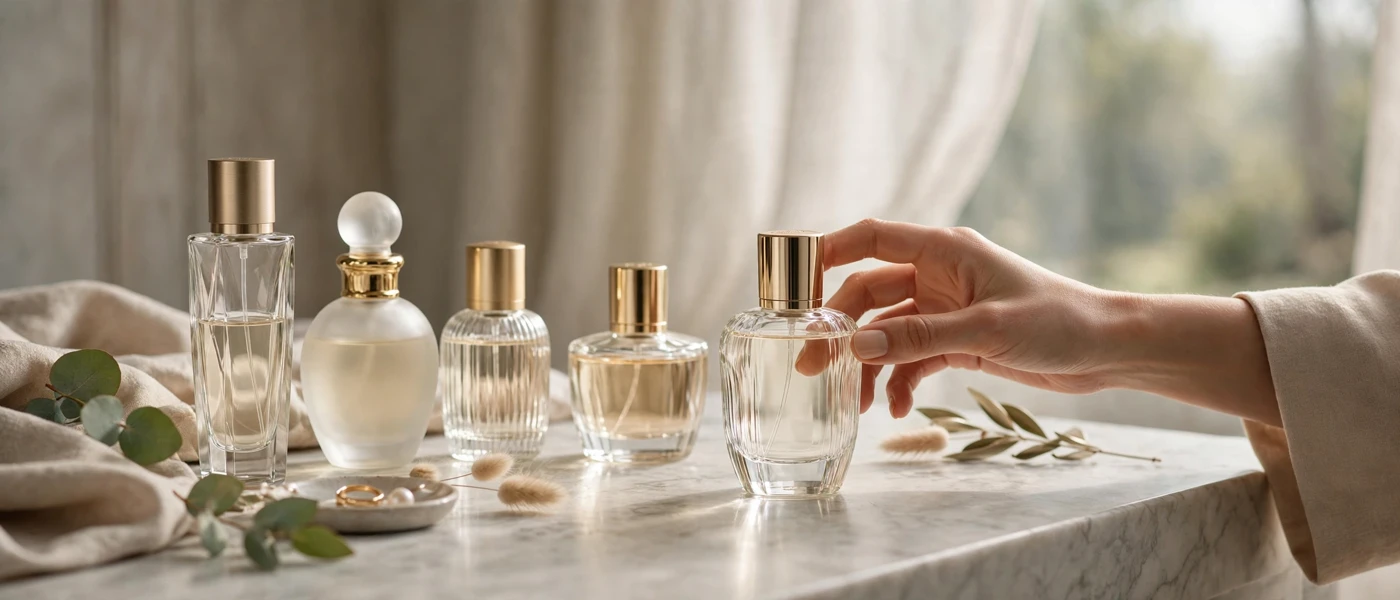

A signature scent does something subtle but powerful: it becomes part of how people remember you. Choosing one is not about finding the most expensive bottle or copying a celebrity’s favourite — it is about discovering which fragrance feels like you on an ordinary Tuesday, not just on a special occasion. Learning how to choose a signature fragrance takes a little patience, because perfume changes on skin, evolves over hours and behaves differently across seasons. This guide explains the main fragrance families, how to test properly, and how to narrow a whole counter of beautiful bottles down to the one that is unmistakably yours.
Start with the fragrance families
Almost every perfume belongs to a family, and knowing which families you are drawn to cuts the search dramatically. Fresh fragrances lean on citrus, green notes and light florals — clean, bright and easy to wear. Florals range from delicate single-flower scents to rich bouquets. Warm, resinous fragrances built on amber, vanilla and spices feel enveloping and suit evening or cooler weather. Woody scents, centred on sandalwood, cedar and vetiver, read as calm and polished.
Think about the scents you already love in daily life — a particular soap, a garden herb, rain on stone, a leather bag. Those preferences are clues. The great luxury perfume houses build their collections across all these families, so once you know your direction, their counters become a pleasure to explore rather than a maze.
How to choose a signature fragrance: test on skin, not paper
A paper blotter tells you only a fragrance’s first five minutes — the bright top notes that are designed to make an opening impression. Perfume is composed like music: top notes fade, heart notes form the character, and base notes are what linger on your coat the next day. Your signature lives in the heart and base, so you must wear a fragrance to judge it.
Test no more than two fragrances at a time, one on each wrist, and do not rub your wrists together, which crushes the development. Then leave the shop. Live with the scent for several hours. Notice how it changes, how long it lasts, and — most importantly — whether you keep enjoying it or start wishing it would fade. Ask for samples of your finalists and wear each for a full day before deciding. A fragrance you still love at hour eight, in real life rather than in a boutique, is a genuine candidate.
Match the fragrance to your life
A signature fragrance should suit the life you actually lead. Consider where you spend your days: a bold, projecting scent may be wonderful in the evening yet overwhelming in a small office or on public transport. Think about strength — lighter eau de toilette formulations wear closer to the skin, while eau de parfum lasts longer and announces itself more.
Climate matters too. Heat amplifies perfume, so the rich scent that feels luxurious in January can become heavy in July. Some people solve this with one year-round signature worn in different strengths; others keep the same fragrance family but a lighter version for summer. Neither is wrong. What defines a signature is recognisability, not rigidity — the same instinct for coherence that guides a considered luxury skincare routine: few products, chosen well, used consistently.
Common mistakes when choosing
Buying the first thing you like. First impressions in perfume are literally the top notes — the part that disappears fastest. Always wear before you buy.
Choosing for compliments alone. Other people’s approval is pleasant, but you are the one living inside the scent all day. If it does not please you, it will end up unworn, like the wrong shade from even the best beauty products — quality cannot rescue a poor personal match.
Testing too many at once. After four or five fragrances your nose stops distinguishing them. Shortlist ruthlessly and return another day.
Ignoring the dry-down. The base notes are your signature for most of the day. Judge a perfume by how it smells at lunchtime, not at the counter.
How many sprays, and where to apply them
Application is part of the signature. Fragrance rises with warmth, so pulse points — the sides of the neck, behind the ears, the chest, the inner elbow — carry it well. Two to four sprays suit most perfumes; a very strong scent may need only one, and a light one might take a mist over clothes as well, since fabric holds fragrance longer than skin. Resist spraying into the air and walking through it: most of the perfume ends up on the floor, and what lands is uneven.
Moisturised skin holds scent longer, so applying after a neutral, unfragranced body lotion extends the day. And never store your chosen bottle on a sunny windowsill or above a radiator — heat and light quietly rewrite the composition you fell in love with, which is why serious collectors treat storage the way archivists treat paper.
Making it truly yours
Once you have chosen, commit for a while. Wear your fragrance daily for a few weeks; this is when it settles into being associated with you, and when you learn its behaviour — how many sprays, which pulse points, how it sits on fabric versus skin. Store the bottle away from sunlight and bathroom humidity so it stays true.
There is a quiet confidence in being recognised by a scent, and it belongs to the same tradition of personal presentation that good beauty writing has celebrated for generations: not novelty for its own sake, but the polish of knowing what suits you. And when you are ready to place your chosen scent in the wider landscape of the UK beauty industry, you will find your taste has become sharper everywhere. Take your time, trust your skin over the sales pitch, and let the fragrance choose you back. The search itself is part of the pleasure: every blotter you reject teaches you something about your own taste, and when the right scent finally settles on your skin and feels inevitable, you will know the search is over.