
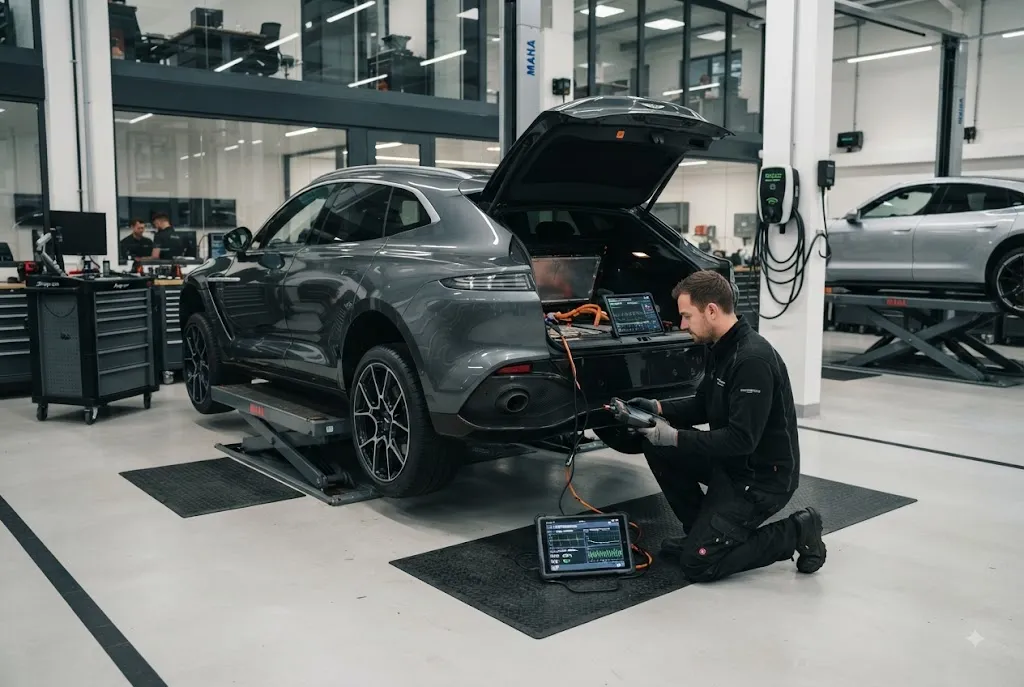

Regular EV servicing is essential for owners of luxury electric vehicles who want to maintain safety, performance and long-term reliability. Although battery-electric cars have fewer conventional moving parts than petrol or diesel vehicles, they still require professional inspections, software and electrical checks, tyre maintenance, brake care and attention to high-voltage systems.
For premium electric vehicles, servicing can be even more important because sophisticated models often combine large battery packs with advanced driver assistance systems, powerful electric motors, electronic suspension, complex thermal management and extensive onboard technology. Choosing the right workshop therefore involves more than finding a convenient service centre. Owners need to consider technician training, diagnostic capability and experience with the specific vehicle.
Why EV Servicing Matters for Luxury Electric Vehicles
An electric vehicle does not need conventional engine oil or many of the components associated with an internal combustion engine. However, that does not mean it is maintenance-free.
Electric vehicles still use tyres, brakes, steering components, suspension systems, cooling systems, 12-volt electrical systems and numerous electronic control units. The high-voltage battery and electric drivetrain also require appropriate monitoring and inspection.
The Driver and Vehicle Standards Agency’s current MOT guidance specifically recognises electric and hybrid vehicles. It notes that propulsion batteries carry high voltage and that additional care is required when inspecting them. ([GOV.UK](https://www.gov.uk/guidance/mot-inspection-manual-for-private-passenger-and-light-commercial-vehicles/4-lamps-reflectors-and-electrical-equipment))
For luxury EV owners, the objective should therefore be preventative maintenance rather than waiting until a warning appears on the dashboard.
What Does EV Servicing Include?
The exact service requirements vary between manufacturers and models. There is no single checklist that applies to every electric car. The manufacturer’s maintenance schedule should always be the starting point.
Depending on the vehicle, a professional EV service may include checks of:
- High-voltage electrical components
- Traction battery condition
- Charging system and charging equipment
- Electric motor and drivetrain systems
- Thermal management and cooling systems
- Brake discs, pads and associated components
- Tyres and tyre pressures
- Steering and suspension
- 12-volt battery and electrical systems
- Lighting and safety equipment
- Vehicle software and diagnostic systems
RAC’s current electric car servicing guidance similarly explains that EV servicing places particular emphasis on electrical systems and battery health, while its full electric service includes visual inspection of high-voltage components. ([RAC](https://www.rac.co.uk/car-care/car-service/electric-car-service))
EV Mechanics Need Specialist Training
EV mechanics require knowledge that goes beyond traditional vehicle maintenance. High-voltage systems can present serious electrical hazards, so technicians working on them need appropriate training, procedures and equipment.
The Health and Safety Executive explains that electric and hybrid vehicles can contain significantly higher voltages than conventional 12-volt or 24-volt vehicle systems. It also states that people involved in repair and maintenance may need substantially greater competence than those carrying out lower-risk activities around the vehicle. ([HSE](https://www.hse.gov.uk/mvr/topics/electric-hybrid.htm))
This makes technician capability one of the most important questions to ask before booking an EV service. A garage that is experienced with tyres and conventional servicing may not necessarily be equipped to diagnose or repair high-voltage systems.
Owners should therefore ask whether the workshop has appropriately trained technicians and whether it has the diagnostic equipment required for their particular EV.
Luxury Electric Vehicles Need More Than Battery Checks
Luxury electric vehicles can be remarkably sophisticated. High-end models may feature multiple electric motors, adaptive suspension, advanced braking systems, sophisticated battery cooling and extensive driver assistance technology.
That means servicing should consider the complete vehicle rather than focusing exclusively on the battery.
For example, a performance EV can place significant demands on its tyres and braking components. A heavy luxury electric SUV may also place different loads on suspension and tyres compared with a smaller city EV.
Consequently, the maintenance approach should reflect the vehicle’s specification, driving environment and manufacturer’s recommendations.
EV Battery Servicing and Battery Health
EV battery servicing does not normally mean opening the battery pack during every routine appointment. Instead, appropriate diagnostic procedures can help assess the condition of the vehicle’s electrical system and identify potential faults.
The high-voltage battery is one of the most valuable components in an electric vehicle, so owners naturally want to understand its condition. However, battery health cannot always be judged accurately from driving range alone.
Range can change because of temperature, driving style, road conditions, tyre pressure, climate-control use and other factors. A professional diagnostic assessment can provide more meaningful information when a battery-related issue is suspected.
Owners should never attempt to dismantle or repair a high-voltage battery themselves. Government guidance for high-voltage vehicle battery handling stresses the need for appropriately trained and qualified technicians when specialist battery work is involved. ([GOV.UK](https://www.gov.uk/guidance/waste-batteries-appropriate-measures-for-permitted-facilities/5-waste-treatment-appropriate-measures))
Charging Infrastructure and EV Ownership
Charging infrastructure is another part of the wider EV ownership experience. While a routine vehicle service does not necessarily involve inspecting every public charger an owner uses, the vehicle’s charging equipment and connection systems can be relevant during maintenance.
Owners should report charging problems rather than assuming they are caused by the public charging network. Issues such as interrupted charging, charging errors or unusual connector behaviour may sometimes originate from the vehicle, its onboard charging equipment or associated electrical systems.
For home charging, owners should also follow the charger manufacturer’s instructions and use appropriately installed equipment. Vehicle servicing and electrical installation are separate areas of expertise, so a garage should not be expected to replace a qualified electrical contractor for domestic charging infrastructure work.
Regenerative Braking Changes Maintenance Priorities
Electric vehicles use regenerative braking to recover energy during deceleration. This can reduce the amount of work performed by conventional friction brakes in some driving situations.
However, EV owners should not assume that brake maintenance is unnecessary. Brake discs, pads and other components still need inspection, particularly because vehicles can experience corrosion or changes in brake use depending on driving patterns.
A proper service should assess the braking system according to the manufacturer’s requirements. If the driver notices vibration, noise, reduced braking performance or unusual pedal behaviour, the vehicle should be professionally inspected rather than relying on regenerative braking to explain the symptom.
Tyres Are Especially Important on Premium EVs
Tyres deserve particular attention because electric vehicles can be relatively heavy and can deliver immediate torque. Luxury performance EVs can place additional demands on their tyres because of their acceleration, weight and handling characteristics.
Incorrect pressures, uneven wear or unsuitable tyres can affect handling, efficiency and range. Drivers should therefore follow the manufacturer’s recommendations for tyre size, load rating and specification.
Uneven tyre wear can also indicate suspension or steering issues. In such cases, checking wheel alignment may be appropriate alongside tyre inspection.
Software and Diagnostics Are Part of Modern EV Maintenance
Electric vehicles depend heavily on software. Vehicle control systems manage battery operation, charging, thermal management, electric motors, safety systems and many other functions.
Some manufacturers can deliver software updates remotely, while others may require certain updates or diagnostic procedures to be carried out through an authorised service network.
This is another reason to choose a workshop familiar with the vehicle’s technology. A technician may need to interpret diagnostic information rather than simply inspect mechanical components.
How Often Should an EV Be Serviced?
There is no universal service interval for every electric vehicle. Manufacturers establish their own schedules according to the vehicle’s design and components.
Some EVs have longer service intervals than conventional vehicles, while others require annual inspections or specific mileage-based maintenance. The vehicle handbook and manufacturer’s service information should therefore take priority over generic advice.
RAC notes that electric cars still require regular servicing according to the manufacturer’s schedule even though they have fewer parts requiring routine repair than conventional cars. ([RAC](https://www.rac.co.uk/drive/electric-cars/choosing/buyers-guide/))
Owners should also arrange an inspection sooner if they notice a warning light, unusual noise, charging problem, tyre issue or change in driving behaviour.
EV Servicing at Authorised Dealerships
An authorised dealership can be an attractive option for owners of newer luxury EVs. Manufacturer-approved technicians should have access to brand-specific service procedures and diagnostic systems, while the dealership may also be able to handle software updates, recalls and warranty-related work.
This can be especially useful when a vehicle is still covered by manufacturer warranty or when a technical issue requires access to proprietary systems.
However, authorised servicing is not necessarily the only option available. Independent workshops can also provide quality EV maintenance when their technicians have appropriate training, equipment and experience.
Independent EV Specialists
The Independent specialists are becoming increasingly relevant as the UK’s electric vehicle population grows. A specialist EV workshop may focus specifically on electric and hybrid systems or combine EV expertise with experience in particular vehicle marques.
When comparing independent providers, ask:
- Are technicians trained to work safely on high-voltage systems?
- Does the workshop regularly service your vehicle’s make and model?
- What diagnostic equipment does it use?
- Can it inspect relevant charging and electrical systems?
- Does it follow the manufacturer’s maintenance schedule?
- What parts and consumables are used?
- Will you receive a detailed service report?
These questions can quickly distinguish a genuinely capable EV specialist from a general garage that has only recently started accepting electric vehicles.
Executive EV Ownership Requires Reliable Support
Executive EV ownership often involves higher expectations around convenience, reliability and customer service. A luxury electric vehicle may be used for business travel, long-distance journeys, client meetings or regular commuting, making unexpected downtime particularly inconvenient.
A good service provider should make maintenance predictable. Digital booking, clear quotations, vehicle health reports and timely communication can all improve the ownership experience.
For business users and high-mileage drivers, maintaining accurate service records is also useful. Documentation can help track maintenance expenditure and demonstrate how the vehicle has been cared for when it is eventually sold or transferred.
Premium Maintenance for Luxury EVs
Premium maintenance should focus on the complete ownership experience rather than simply charging the battery and replacing worn components.
For a luxury EV, attention to detail can extend to tyre condition, wheel alignment, suspension calibration, brake condition, charging systems, software, cabin technology and driver assistance features.
Advanced driver assistance systems can also depend on correctly calibrated sensors and cameras. If a vehicle undergoes certain repairs involving steering, suspension, windscreen replacement or bodywork, the manufacturer may specify additional calibration procedures.
This makes it important to use a workshop that understands the interaction between mechanical repairs and electronic systems.
EV MOT Testing Is Still Required
Electric vehicles are not exempt from MOT testing. GOV.UK states that cars generally require an MOT from their third anniversary and annually thereafter, subject to the applicable rules. ([GOV.UK](https://www.gov.uk/getting-an-mot))
The MOT is different from a full service. It checks whether the vehicle meets specified road safety and environmental standards at the time of testing. It does not replace the manufacturer’s maintenance schedule.
GOV.UK’s MOT inspection manual also states that batteries must be inspected on electric and hybrid vehicles, while highlighting the high-voltage risks associated with propulsion batteries. ([GOV.UK](https://www.gov.uk/guidance/mot-inspection-manual-for-private-passenger-and-light-commercial-vehicles/4-lamps-reflectors-and-electrical-equipment))
Therefore, EV owners should keep up with both their scheduled servicing and statutory MOT requirements.
Warning Signs That Should Not Be Ignored
Electric vehicles can provide extensive dashboard information, so drivers should take warning messages seriously.
Potential reasons to arrange professional assessment include:
- Persistent battery or drivetrain warning messages
- Unexpected reduction in performance
- Charging interruptions
- Unusual electrical noises
- Brake or steering changes
- Unusual tyre wear
- Reduced range that cannot be explained by normal conditions
- Problems with vehicle software or electronic systems
A warning does not automatically indicate a major battery failure. Modern EVs contain many sensors and control systems, and a diagnostic assessment is usually the appropriate first step.
Buying a Used Luxury EV
Prospective buyers should investigate servicing carefully when purchasing a used premium electric vehicle. A low purchase price can be less attractive if the vehicle has an incomplete maintenance history or unresolved technical issues.
Ask for service records and check whether manufacturer-recommended maintenance has been completed. Where appropriate, prospective buyers may also want a qualified specialist to inspect the vehicle before purchase.
Battery condition deserves particular attention because the traction battery is a central component of an EV’s value and performance. However, buyers should avoid relying on informal battery-health claims. A suitable professional assessment is more useful.
EV Servicing and Long-Term Vehicle Value
A well-documented maintenance history can support confidence in a luxury EV’s condition. Keeping records of servicing, inspections, repairs and relevant battery assessments provides a clearer picture of how the vehicle has been maintained.
Good maintenance can also help identify developing problems before they become expensive failures. Tyres, brakes, suspension and electrical systems all contribute to the vehicle’s overall condition, so a complete maintenance strategy is more valuable than focusing exclusively on battery health.
For owners intending to keep the vehicle for several years, following the manufacturer’s service schedule is one of the simplest ways to maintain a structured approach to long-term care.
Choosing the Right EV Service Provider
The best EV servicing provider should combine appropriate high-voltage training, vehicle-specific knowledge, modern diagnostic equipment and transparent customer service.
For some luxury EV owners, the manufacturer’s authorised dealership will provide the preferred combination of technical support and warranty services. For others, an independent specialist may offer a convenient alternative, particularly once the vehicle is outside its original warranty period.
Either way, the workshop should be able to explain what it is qualified to do and where manufacturer-specific support may be required.
As electric vehicles become more sophisticated, the definition of automotive maintenance will continue to evolve. The absence of a traditional engine does not remove the need for professional care. Instead, it shifts the focus towards batteries, electrical systems, software, thermal management, tyres, brakes and advanced vehicle electronics.
For luxury EV owners in Britain, choosing a capable service provider and following the correct maintenance schedule can help protect safety, performance and the overall ownership experience for years to come.
